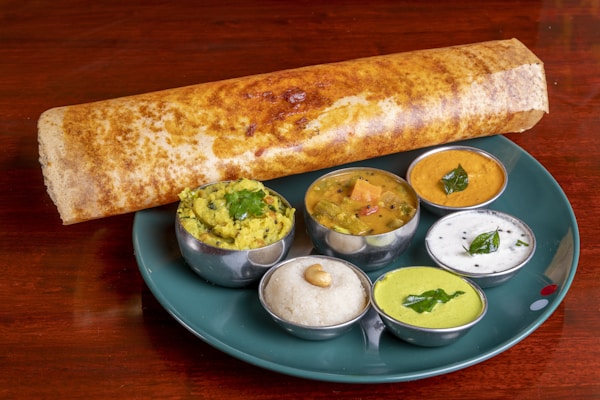
Long before it conquered restaurant menus from Mumbai to Manhattan, the Masala Dosa was a sunrise ritual — a daily act of craftsmanship passed between generations of cooks who measured success not by recipe, but by the sound of the first crackle on a well-seasoned iron griddle.
A Humble Origin Wrapped in History
The exact birthplace of the Masala Dosa is fiercely contested — Udupi's Brahmin kitchens claim it as their own, as does the temple-town of Madurai and the coffee-house lanes of old Bengaluru. What historians largely agree on is this: the dosa in its current form emerged sometime between the 6th and 8th centuries CE, with references to a fermented rice-lentil pancake appearing in the Sangam-era Tamil literature as dosai.
But the Masala in Masala Dosa — the spiced potato filling that transforms a simple crêpe into a complete meal — is a later, colonial-era innovation. The potato arrived in South India only in the 17th century with Portuguese traders, and it was the resourceful cooks of Karnataka's Udupi restaurants who saw its potential: affordable, filling, and perfectly suited to absorb the sharp tang of mustard seeds, the warmth of turmeric, and the herbal brightness of fresh curry leaves.
The Science and Soul of the Batter
Ask any South Indian home cook what separates a great dosa from a forgettable one, and they will invariably begin with the batter. The ratio of rice to urad dal is everything. At Ayyappa Dakshinam, we use a 3:1 ratio of parboiled rice to black gram lentils, soaked separately for a minimum of six hours to allow the starches to soften and the lentils to swell.
The grinding — traditionally done on a heavy granite wet grinder — is not merely mechanical. The stone generates a gentle heat that activates the batter, and the natural inclusion of air during grinding begins the fermentation process. After grinding, the batter rests for 8 to 12 hours, depending on the season. In Jaipur's summer heat, fermentation is vigorous; in winter, the batter needs a warm corner of the kitchen and a little extra patience.
"A properly fermented batter has a gentle sourness, a faint yeasty perfume, and tiny bubbles rising through it. That smell is the smell of tradition working."— Chef Krishnamurthy, Ayyappa Dakshinam
The Masala: Where Simplicity Becomes Magic
The potato filling of a great Masala Dosa is, paradoxically, one of the simplest things to prepare — and yet one of the most frequently mishandled. The potatoes must be boiled until just tender, not waterlogged. The tempering must happen in ghee, not oil. Mustard seeds must splutter fully before the onions go in. And the onions must turn soft and slightly golden, not fried hard.
Our Masala Filling — What Goes In
- Freshly boiled Rajasthan potatoes, roughly broken by hand (never mashed)
- Yellow onions slow-cooked in pure ghee until sweet and tender
- Whole mustard seeds, split urad dal, and a generous pinch of asafoetida for the tempering
- Fresh curry leaves, green chillies, and a sliver of ginger from our kitchen garden
- Turmeric for colour and anti-inflammatory warmth
- A squeeze of fresh lemon at the very end — the secret that lifts everything
The Griddle: A Canvas That Takes Years to Season
A dosa tawa is not bought — it is earned. Our cast iron griddles at Ayyappa Dakshinam have been in continuous use since the restaurant opened, seasoned by thousands of dosas poured upon them, each one adding a microscopic layer of polymerized oil that creates an increasingly non-stick, flavour-imparting surface that no modern non-stick pan can replicate.
The temperature at which the batter meets the tawa is critical: too cool and the dosa steams instead of crisps; too hot and it tears before you can spread it. Our cooks test temperature the traditional way — a few drops of water flicked onto the surface. The moment they vaporise with a sharp hiss, the tawa is ready.
Why Ours Tastes Different
At Ayyappa Dakshinam, we have made a deliberate choice to preserve inconvenient traditions. We grind our batter fresh every morning. We use only cold-pressed coconut oil and pure cow's ghee. Our sambhar is simmered for four hours with a base of tamarind, toor dal, and a proprietary blend of 11 spices roasted and ground in-house each week.
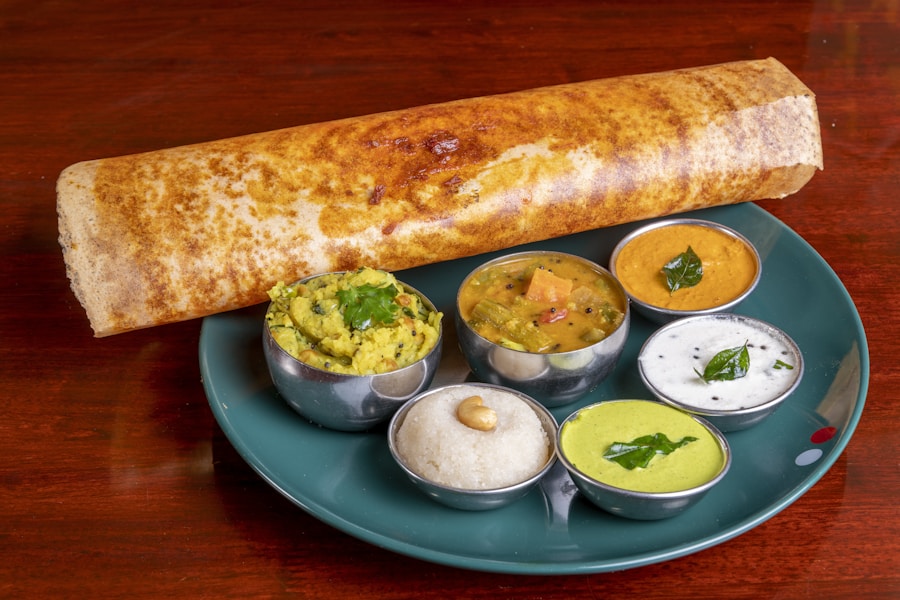
We also serve our Masala Dosa the way it was meant to be served: hot off the tawa, plated immediately, with the chutney and sambhar in separate small bowls so the dosa retains its crispness for the maximum time possible. No soggy dosas at Ayyappa Dakshinam — ever.